Neonatology
The newborn exam, resuscitaire prep, feeds and NICU pearls.
Use as a study guide only. These notes are part of a free open-access medical education (FOAMed) project and may contain errors or outdated information. Always verify against current guidelines (e.g. eTG, RACGP, local health district policies) and reputable sources before applying anything to patient care. See the full disclaimer.

Clinical pearls & learnings
Tips and tricks collected over the years — a living list that grows with every rotation. Use as a study guide only and check current guidelines before acting on anything.
Neonatology pearls
Resuscitaire preparation
Call for help early if there is a reason to expect a difficult transition — prematurity, instrumental delivery, prolonged labour, or thick meconium.
- Turn on the resuscitaire light and heater to 100%
- Have all airway equipment and suction ready on standby
- Connect the gas inlet to air at 10L/min
- Connect the gas outlet to the T-piece mask
- Set PEEP 5cmH₂O and PIP 30cmH₂O (bag valve seat to PEEP 5cmH₂O, PIP automatically limited to 40cmH₂O)
- Position the baby's head towards the end of the resuscitaire
- Auscultate the heart rate on the baby's left side
- Watch the baby's chest rise, not the manometer.
- Ventilate at 60 breaths per minute.
- Escalate from CPAP to IPPV as needed.
- Airway positioning escalation: one-hand jaw support with head tilted forward, then two-hand jaw thrust with a second person delivering IPPV.
Cephalohaematoma vs subgaleal haemorrhage
| Crosses suture lines / midline? | |
|---|---|
| Subgaleal haemorrhage | Yes — crosses the midline |
| Cephalohaematoma | No — confined by suture lines, does not cross the midline |
Always check the shoulders and clavicles for fractures after breech delivery or shoulder dystocia.
Reading a neonatal CT head
- A neonatal CT always looks abnormal to the untrained eye — there is no atrophy and poor grey–white differentiation because myelination hasn't happened yet. This is normal for age.
- Always actively exclude: haemorrhage, ventriculomegaly, raised ICP, venous sinus thrombosis, infarction and diffuse cerebral swelling.
- Check that all the cisterns are present.
- Follow up with MRI DWI to check for diffusion restriction from small infarcts — CT alone can miss these.
- Consider SIDS vs HIE as differentials in the collapsed neonate.
- All infarcts are haemorrhagic to some degree — severity is what varies.
- Untreated pneumonia can progress to a multiloculated effusion.
- Material at the lung bases can be proteinaceous and fibrinous — tough to push an ICC through once organised.
- For back pain, consider vascular haematoma, epidural abscess, osteomyelitis and discitis.
Newborn seizure vs normal neonatal movements
Features favouring normal neonatal movements over seizure
| Feature | Favours normal movement |
|---|---|
| Pattern | Movements occur in succession, not simultaneously |
| Duration | A few seconds, non-sustained |
| Amplitude | Low amplitude |
| Associated features | No tonic posturing, rhythmic clonus, apnoea, central colour change or lip smacking |
| Background | No IVH or intracranial pathology on serial scans |
Worked example: settled/asleep but reactive to examination, PEARL with brief fixing on the face, normal tone and spontaneous activity in all limbs, 2 beats of clonus, mildly brisk (equal, bilateral) lower limb reflexes, symmetrical Moro, intact grasp/suck/rooting, normal BSL and gas (pH 7.4, pCO₂ 36, Na 138, K 5.4, iCa 1.38, Hb 116, glucose 5.1, lactate 1.39) — impression: within the realms of normal neonatal movements, not consistent with seizure activity.
TAPVD (total anomalous pulmonary venous drainage)
Pulmonary veins drain into the systemic circulation instead of the left atrium. The PDA must stay patent to allow oxygenated blood to reach the systemic circulation — give prostaglandin (PGE1) to keep it open.
Jaundice — beware of sepsis
Neonatal jaundice can be the presenting sign of sepsis — don't anchor on physiological or breastfeeding jaundice without considering it.
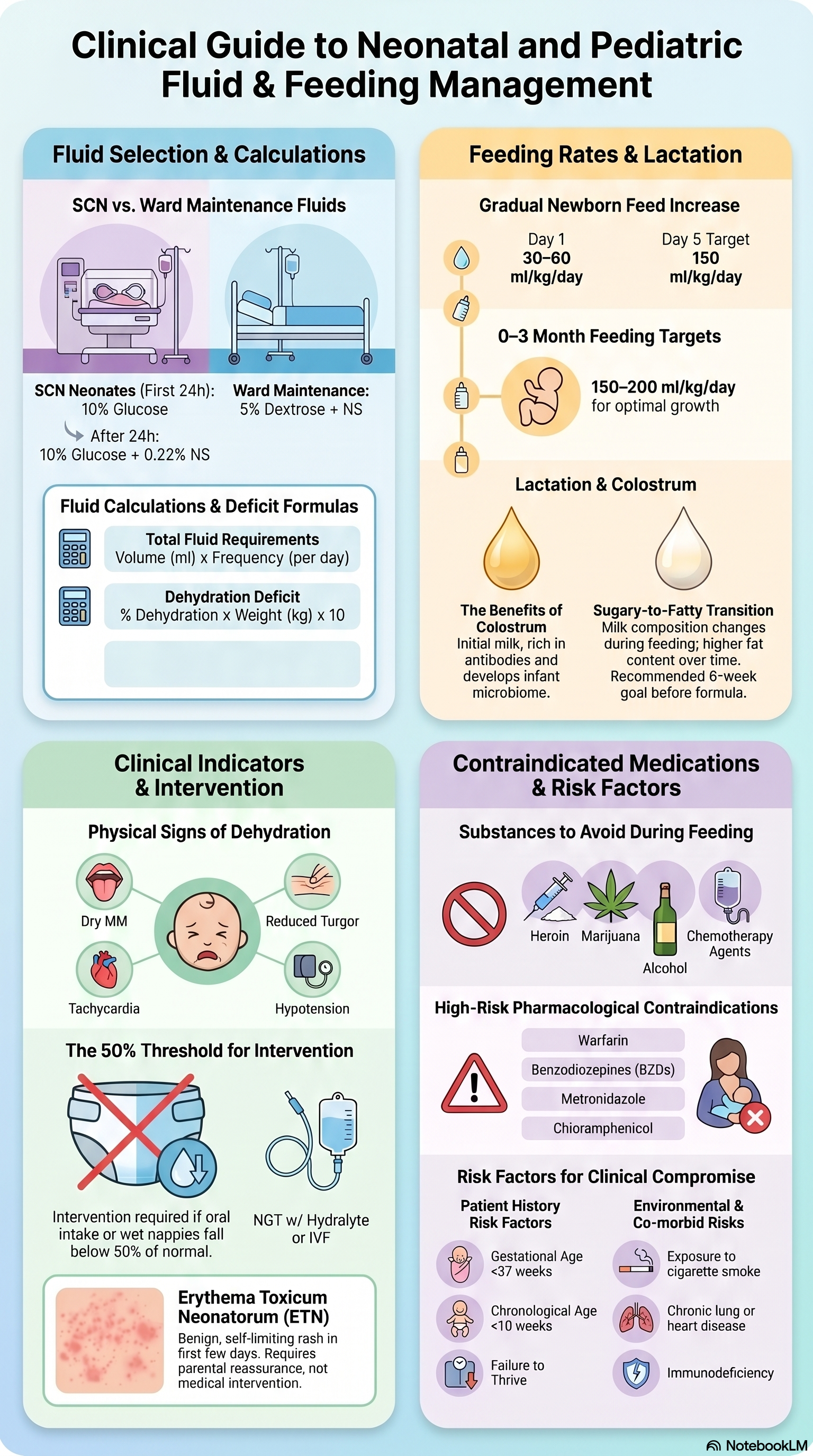
Neonatal feed rates
Newborn feed build-up (feed volume vs total fluid rate, TFR)
| Day | Feed (mL/kg/day) | Total fluid rate (mL/kg/day) |
|---|---|---|
| Day 1 | 30 | 60 |
| Day 2 | 60 | 90 |
| Day 3 | 90 | 120 |
| Day 4 | 120 | — |
| Day 5 | 150 | — |
- 0–3 months: typical feed rates are 150–200 mL/kg/day.
- 0–6 months: roughly 2.5oz (75mL) per pound of body weight daily.
Clinical guide to neonatal and paediatric care — poster