General Practice
Prescribing pearls, deprescribing, aged care and reference values collected from general practice.
Use as a study guide only. These notes are part of a free open-access medical education (FOAMed) project and may contain errors or outdated information. Always verify against current guidelines (e.g. eTG, RACGP, local health district policies) and reputable sources before applying anything to patient care. See the full disclaimer.
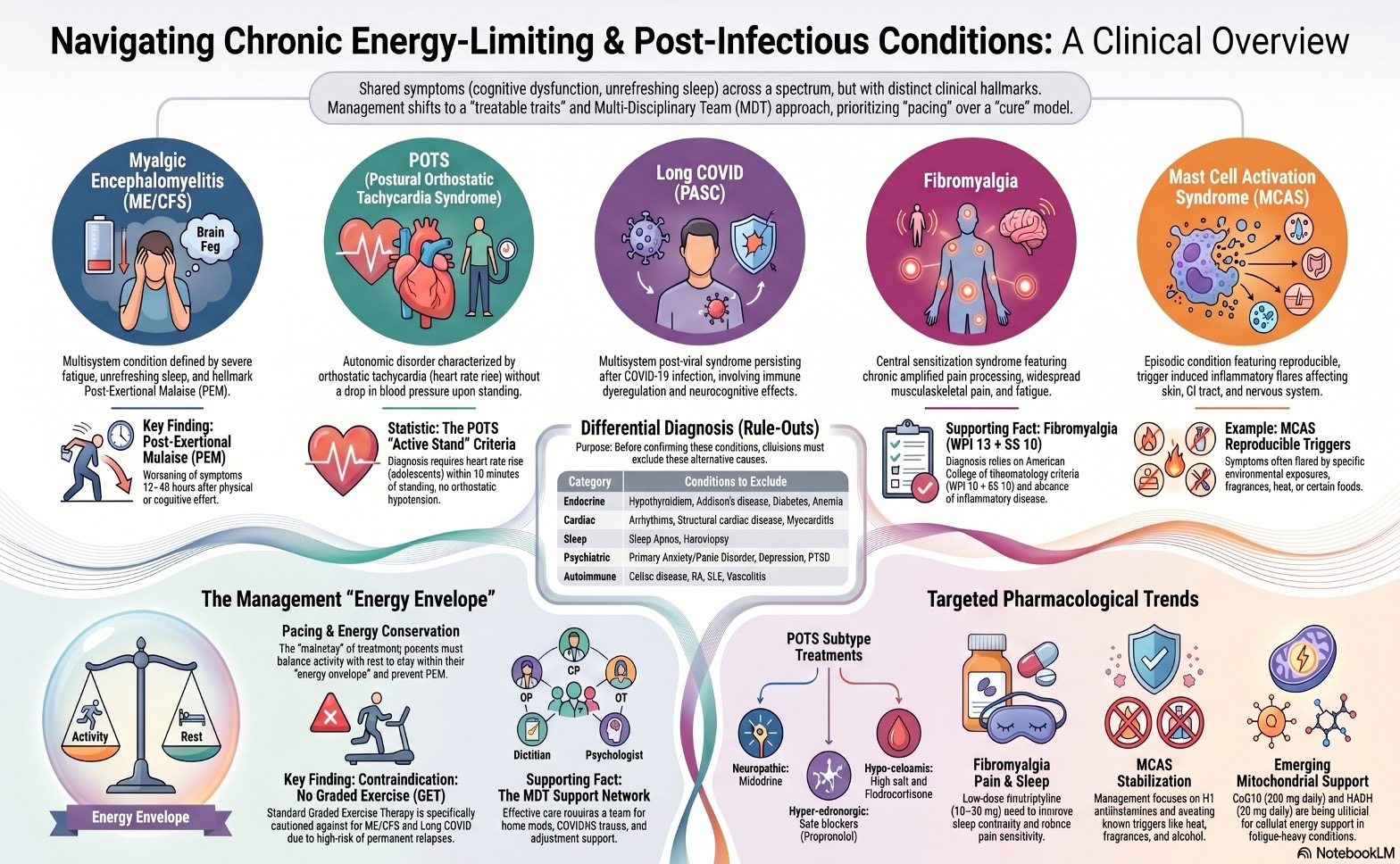
 Navigating Chronic Energy-Limiting & Post-Infectious Conditions — PosterPDF · opens in a new tab
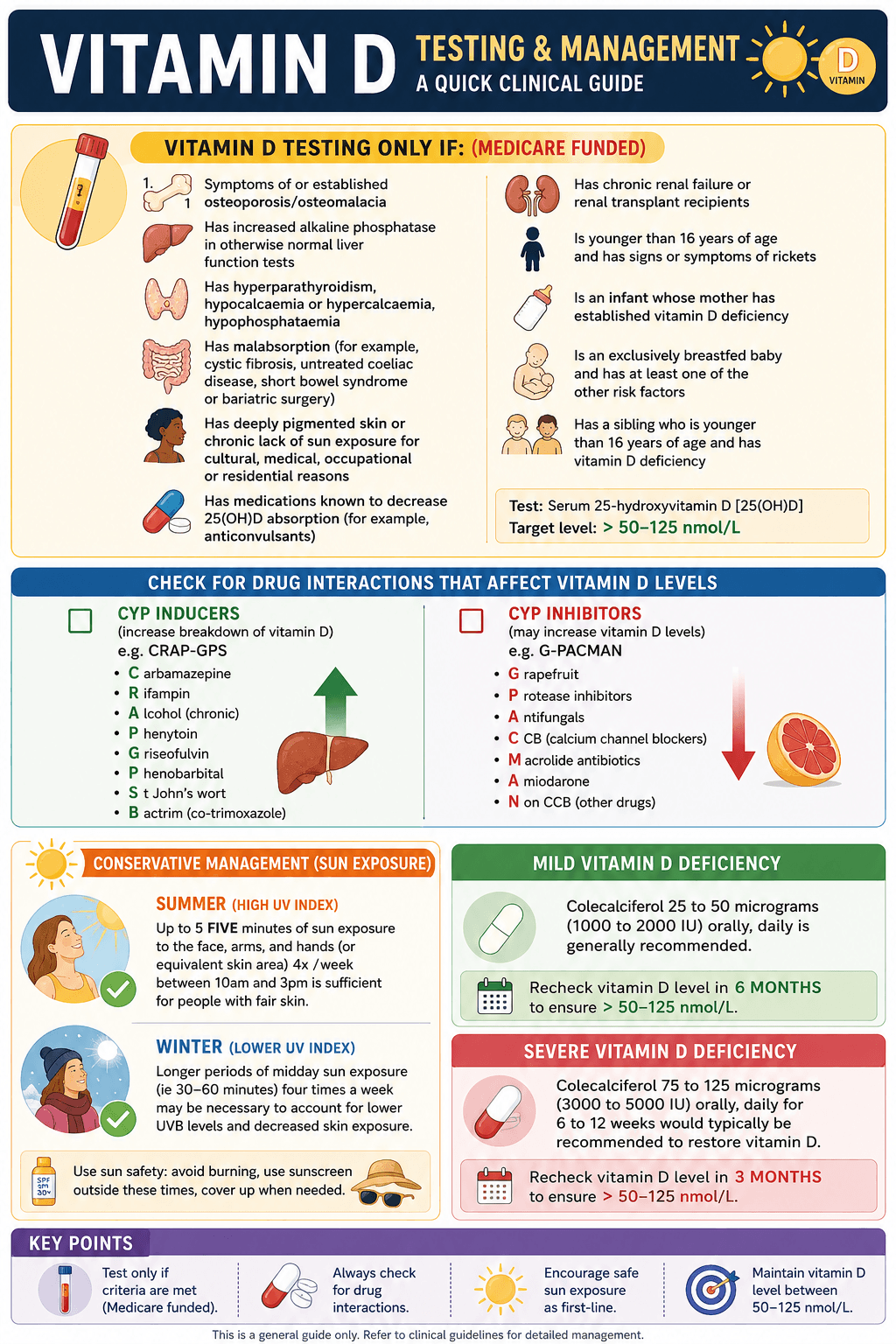 Vitamin D — PosterPDF · opens in a new tab
Clinical pearls & learnings
Tips and tricks collected over the years — a living list that grows with every rotation. Use as a study guide only and check current guidelines before acting on anything.
What's normal? Reference values
Steroid, insulin & fluid quick reference
Numbers worth knowing cold
| Quantity | Value | Note |
|---|---|---|
| Glucocorticoid equivalence | Dexamethasone 1mg ≈ prednisolone 6–7.5mg | Dexamethasone is far more potent per mg |
| Physiological cortisol production | ≈ 5mg prednisolone/day | Useful for stress dosing or weaning long-term steroids |
| Endogenous insulin production | 18–40 units/day (0.2–0.5 U/kg/day) | Basal secretion ~0.5–1.0 U/hour |
| Adult maintenance fluid | ~35mL/kg/day | Adjust down for elderly, heart failure, renal impairment; up for ongoing losses |
Prescribing & targets
Starting an ACE inhibitor/ARB
An early rise in creatinine after starting an ACEi/ARB is expected — up to a 30% rise (with eGFR falling proportionately) is acceptable and reflects the drug's intended effect on glomerular pressure. A larger rise should prompt dose reduction/cessation and investigation for renal artery stenosis.
Blood pressure & lipid targets
Targets by context — always check current local guidance
| Context | Target |
|---|---|
| CKD with proteinuria | Guidelines increasingly favour ~120–130 systolic with an ACEi/ARB for renoprotection |
| T2DM without CKD or microalbuminuria | <140/90 |
| Post-STEMI (very high cardiovascular risk) | LDL <1.4mmol/L, with at least a 50% reduction from baseline |
Gestational diabetes and future risk
Up to around 40% of women with gestational diabetes go on to develop type 2 diabetes within 10–15 years — an important opportunity for ongoing lifestyle counselling and periodic glucose screening after pregnancy.
Postural (orthostatic) hypotension — pharmacological options
Non-pharmacological measures first (hydration, compression stockings, slow position changes). Fludrocortisone and midodrine are the standard first-line pharmacological options. Moclobemide has been used off-label in refractory neurogenic orthostatic hypotension, but it's a specialist-level option, not routine second-line. A practical, low-cost sodium supplementation option in Australia is a high-salt beef extract product (e.g. Bonox).
Long-term PPI use — worth revisiting
Long-term proton pump inhibitor use has been linked in observational studies to increased risk of respiratory infections and other complications (fracture, C. difficile infection, B12/magnesium deficiency). Evidence for a direct causal link to new asthma or COPD is less clear-cut than some other associations, but the broader point stands regardless: PPIs are frequently continued well past their original indication. Periodically review whether the dose can be reduced or the drug ceased.
Nausea — a general step-up ladder
- Ondansetron or metoclopramide
- Cyclizine
- Droperidol or dexamethasone
Tailor to the cause and the patient — avoid metoclopramide/droperidol in Parkinson's disease (dopamine antagonism can worsen symptoms), and be cautious with ondansetron/droperidol where there's a long QT or other QT-prolonging medications on board.
Common medication-timing pearls
When to take it, and why
| Medication | Timing | Why |
|---|---|---|
| Levothyroxine; oral bisphosphonates (alendronate, risedronate) | Empty stomach, at least 30 minutes before food or other medications | Food and other drugs impair absorption |
| Metformin | With food | Reduces GI side effects |
| Oral iron | With vitamin C | Keeps iron in the more absorbable ferrous state |
Goals of care & prognosis
Rough survival benchmarks
Malignant ascites and malignant pericardial effusion are both markers of advanced, poor-prognosis disease — malignant ascites carries a median survival often cited around 8 weeks, and malignant pericardial effusion around 4 weeks. These figures vary considerably by underlying malignancy and should inform, not substitute for, a proper goals-of-care conversation.
Work-up frameworks
Progressive functional decline — a broad screen
- Bloods: CK, troponin, TFTs, ESR.
- Myositis panel where an inflammatory myopathy is possible.
- Autoimmune screen: ANA, ENA, ANCA, anti-dsDNA, RF, anti-CCP, C3, C4.
- Imaging: CT brain + angiogram, escalating to MRI whole spine and brain with contrast if a central or compressive cause is suspected.
Primary immunodeficiencies — not all the same defect
| Condition | Defect | Key feature |
|---|---|---|
| Chronic granulomatous disease (CGD) | NADPH oxidase defect — phagocytes engulf but can't kill effectively (most commonly X-linked, but autosomal recessive forms exist) | Recurrent infection with catalase-positive organisms (Aspergillus, S. aureus) and granuloma formation — a phagocytic defect, not autoimmune |
| Bruton's (X-linked) agammaglobulinaemia | BTK gene defect — B cells fail to mature | Recurrent bacterial infections from infancy, absent B cells/immunoglobulins |
| Hyper-IgM syndrome | CD40L defect — impaired immunoglobulin class-switching | High/normal IgM with low IgG/IgA/IgE |
| SCID | Combined T- and B-cell defect | Severe infections from early infancy — a paediatric emergency |
Aged care
Restless legs syndrome
- Check ferritin — the treatment threshold for RLS is higher than for standard iron deficiency, generally supplementing if ferritin is below about 75microgram/L.
- Lifestyle: reduce caffeine and alcohol, warm baths before bed.
- Alpha-2-delta ligands (gabapentin, pregabalin) are now generally preferred first-line pharmacological treatment.
- Dopamine agonists (pramipexole, ropinirole) are an alternative, but carry a real risk of augmentation (symptoms worsening or starting earlier in the day) with long-term use.
Tremor — don't conflate the types
Propranolol (first-line) then primidone (second-line) is the standard ladder for essential tremor — a postural/action tremor. This doesn't apply to a true intention tremor (worsening on approaching a target, e.g. finger-nose testing), which is a cerebellar sign; there's no reliable first-line drug for it, and management focuses on the underlying cause.
Dementia vs mild cognitive impairment
The key distinction is functional impact: dementia (major neurocognitive disorder) involves a measurable reduction in activities of daily living, whereas MCI (mild neurocognitive disorder) features early memory loss with functional independence largely retained.
Iron deficiency in heart failure
Iron deficiency is common in heart failure (up to around half of patients) and easy to miss — ferritin can be falsely reassuring because it's an acute phase reactant that rises with the chronic inflammatory state of HF. Diagnostic criteria: ferritin <100microgram/L, OR ferritin 100–299microgram/L with transferrin saturation <20%.
IV iron is preferred over oral in heart failure — gut oedema impairs oral absorption, and trial evidence (e.g. AFFIRM-AHF, CONFIRM-HF) supports IV iron for improving symptoms and reducing HF hospitalisation.
Assessing carer burden
The Zarit Burden Interview is a validated tool for evaluating carer burden across multiple domains — physical strain, emotional distress, social restriction and financial impact.
Infection & public health
Exclusion periods and screening
- Salmonella: exclude from work/school (particularly food handlers, childcare and healthcare workers) until at least 48 hours after symptoms resolve.
- Hepatitis A: in an endemic-exposure setting, check food and travel history; in a non-endemic setting, take a sexual history — particularly men who have sex with men.
- Do not give the live varicella vaccine to immunocompromised patients or those who've had a recent blood transfusion/blood product (live vaccines are generally deferred for a period after blood products, as passive antibodies can blunt the vaccine response) — check current timing guidance for the specific product given.
MRSA decolonisation
Considered for recurrent MRSA infections, household clusters, healthcare workers with persistent carriage, or outbreak control.
"Nose + body for 5 days": mupirocin massaged into both nostrils, plus 4% chlorhexidine body wash used everywhere daily, plus chlorhexidine shampoo on days 1, 3 and 5.